A common point of discussion when working towards peace is defining what peace is and isn't, what it looks like, which activities are considered "peaceful" and which are not.
I think at the extreme ends of the spectrum, most people can agree on what peace is and isn't. For example, most people would consider dropping bombs on other people to be the opposite of peace. Most people would consider the silent prayer/meditation for world peace and the om to be examples of peace.
That's the easy stuff. In fact trying to define peace can cause even the most peaceful among us to be less than peaceful. So what do we do if we say we want peace, but we can't even agree on what peace looks like, feels like, acts like or talks like?
I'll throw out a couple of high level ideas, but even these are subject to much discussion. I hope you continue these discussions in the circles in which you find yourself.
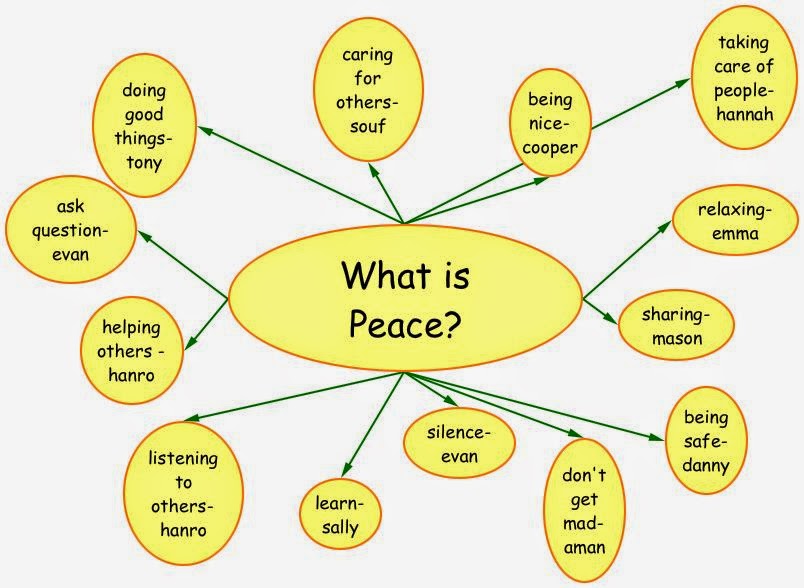
What is Peace?
First graders have a very good concept of peace (image from Miss Krug's
Our Grade One blog):
Some people view peace as the absence of war or violence. Perhaps this view comes to us from Ancient Greece in the goddess
Eirene the goddess of peace, who also celebrates decisive battles that end wars. If we subscribe to this paradigm, we probably are following the axiom "the ends justify the means."
Another high level view of peace is one that focuses on harmony and tranquility that can take the form of an inner state or a state between people. We can say
she is always tranquil and peaceful or
they have a harmonious marriage.
Peace can be considered as cooperation between people in a social group or culture to maintain a certain level of social order.
Keep in mind that slavery existed in the USA during times of peace and for me, slavery does not equal peace.
 |
| Liberian Women for Peace |
The
Global Peace Index (GPI) attempts to identify countries by their level of peacefulness focusing on various formal military measures, prisoners per capita, refugees, wars, etc.
In the last hundred years, peace has been tightly coupled with the idea of non-violence. So now we have to define what non-violence is and how non-violent methods contribute towards creating peace. Now I'm sure most of you are familiar with the teaching of the Dalai Lama, Mahatma Gandhi, and Martin Luther King Jr. -- all of which emphasis non-violence --another problematic concepts. Defining non-violence is just as hard as defining peace (but I think by now you know how to approach this issue.)
The Dalai Lama offers these words, "Peace can only last where human rights are respected, where the people are fed, and where individuals and nations are free." Of course now we have to figure out what "free" really means. For example, do we include the freedom to harm others in the word free? Or are your freedoms curtailed when they impact my freedoms? How does your pollution impact my freedom?
Peace is often negotiated between groups of people. For example, a family, school, city or state negotiate what they see as peace.
International Alerts writes, "Peace is when people are able to resolve their conflicts without violence."
If the absence of violence is our definition of peace, we end up with enforced peace. Sometimes peace is enforced by governments and when the force disappears so does the peace. I would argue that this is not a true peace. Perhaps it is a moment when true peace can take hold or perhaps it is just a halt to the fighting for a short period of time.
Working towards peace is nothing new. In 1915, the Women's Peace Party traveled to Europe on the Peace Ship to try to negotiate peace during World War I. We all know how that turned out.Even clowns get into the mix with World Peace Clowns. Check out the link to Patch Adams - an early gatherer.Am I always a peaceful person? That's a good question. I try to be, but then again, what seems peaceful to me, may not be peaceful to another person. How then to resolve all these paradigms of peace?One method we use at the Rainbow Gathering during a conflict is to sit in a circle and give everyone an opportunity to share their thoughts and feelings, recommend solutions, discuss options and try to find a win-win solution. Another tool I love to use is sitting down and oming, chanting, or being silent so we create space for peace to take root.
Another method that works well both within the gathering and outside the gathering is the idea of zoning. Some camps like to be up late at night making lots of noise. Other camps prefer the early to bed, early to rise model. When these two camps are next to each other conflict arises which then removes peace. Neither camp is right or wrong. The issue is that they just are not compatible in close proximity. Zoning is what this is called in the big city.
The Answer to the Question: What is Peace?
The short answer is I do not have one answer.The long answer is that I hope I've gotten you thinking about your own actions and peace as well as the community around you and peace.I believe in peace as something we "practice" much like meditation rather than something we "get" such as a new pair of shoes. The more people practice peace, the strong the peace becomes. The more experience we have with the practice of peace, the better we get at it.
The muse of peace invites you to come to the gathering and practice your peace with this crazy family I so dearly love. This family will test your patience, change the way you look at the world and yourself, teach you new things, and provide a wonderful opportunity to "practice peace" with others. I hope to see you at the 4th of July Silent Prayer/Meditation for World Peace in Main Meadow practicing your peace.
"The most valuable possession you can own is an open heart. The most powerful weapon you can be is an instrument of peace." ~~~~ Carlos Santana


Comments
Post a Comment
I look forward to comments that avoid racist, sexist, homophobic, and/or other 'ism' language & that does not advocate violence or spread lies/rumors.